SAT Study System
- Ref
- U6
- Category
- software
- Status
- in use
- Year
- 2026
- Rev
- B
Timed SAT study sheets for the Supernote, built from the College Board question bank, where the times I write down decide what I study next.
The SAT Study System turns the College Board’s free SAT question bank into study sheets I can write on, and then uses the times I write down to decide what I study next. Each study block gets one ready-made notebook on my Supernote: the questions, space to work, a box for my time, and the worked solution on the page after. It’s built on the same renderer as xiehanzi, my Chinese handwriting sheets, and is open source under the AGPL like it.
Most study plans tell you what to study and when, but not what to actually do once you sit down. With a full working week, my study blocks are at 06:00 or in the evening, and “practise quadratics” at 06:00 meant spending the first fifteen minutes picking questions, deciding how many, and finding the solutions, which on some days was enough to stop me starting at all. So the idea here is that when I sit down, everything is already decided, and I just open the sheet and start.
The second idea is that on the maths section, the problem is usually speed rather than knowledge. The real test gives you about 95 seconds a question, which is plenty when the method comes to you straight away and nowhere near enough when it doesn’t. I treat that as a hypothesis rather than a fact, so every question is timed, and if a sweep comes back fast but wrong, that says the gap is knowledge and the answer is teaching, not drilling.
How a session works
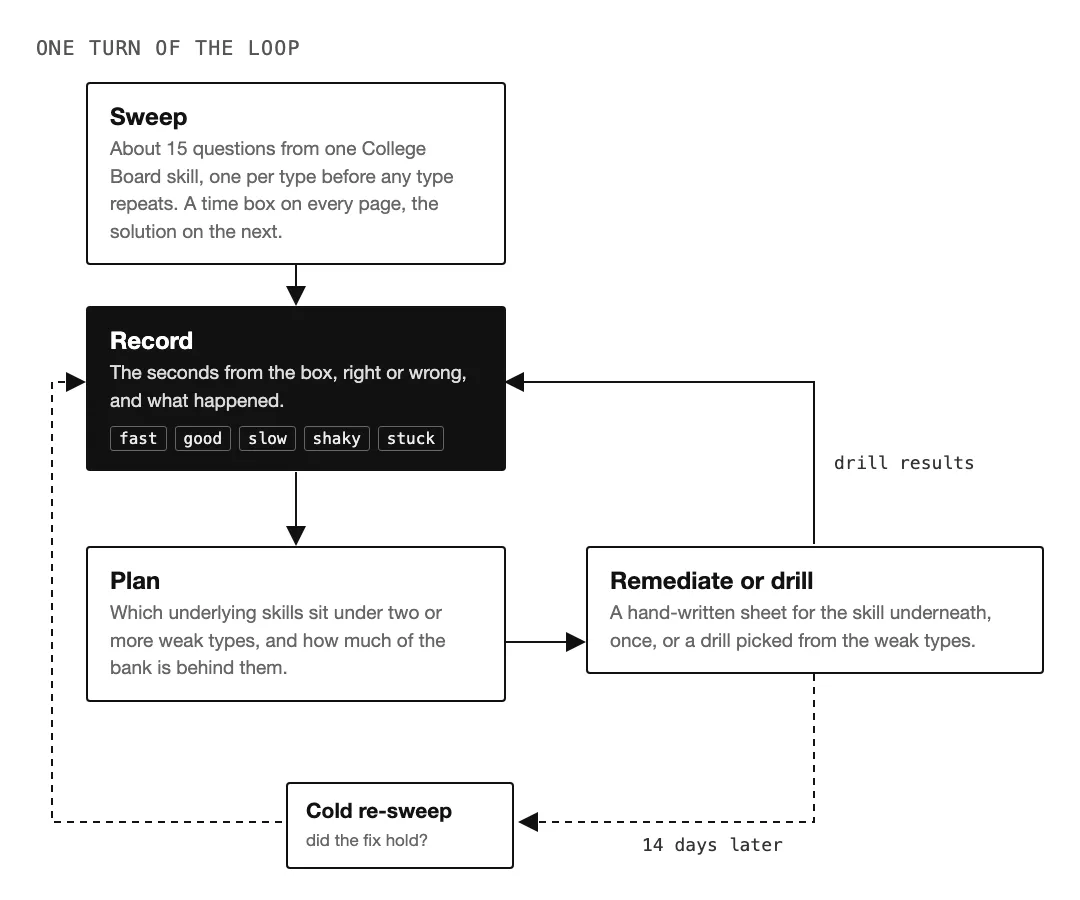
The loop. Everything starts from a sweep, and everything ends up back in the record.
A sweep is a coverage check, not a lesson. It takes about 15 medium and hard questions from one of the College Board’s maths skills, rotating through every type of question in that skill before any type comes up twice. Each question gets its own page with a time box, and the page after it has the official answer, a one-line cue for recognising that type of question, the procedure a fast solver would use, and a short checklist of what happened. The type is never named on the question page, seeing as recognising it within a few seconds is part of what’s being measured.
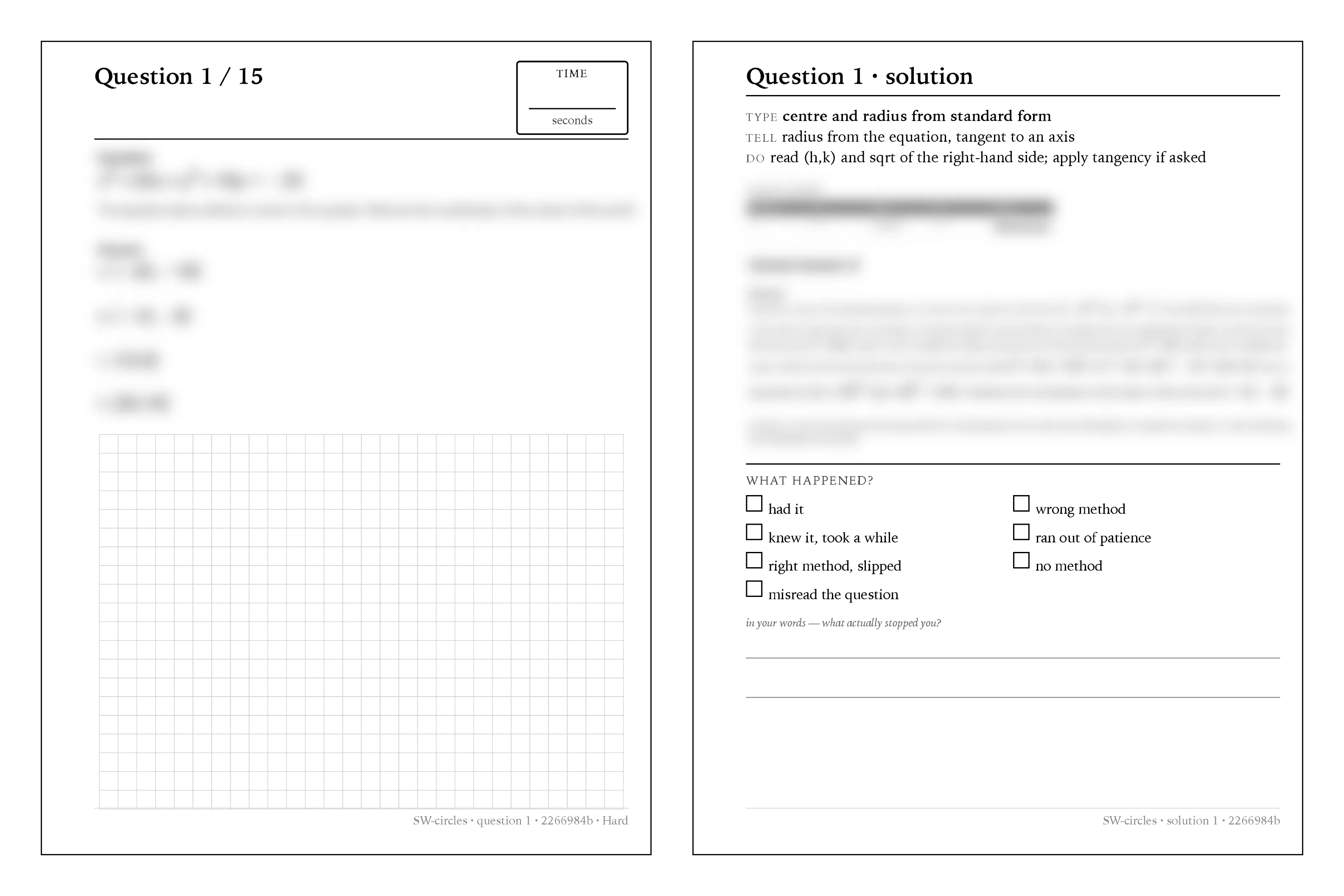
A question and its solution page from a sweep. The College Board’s question and rationale are blurred here, on every page that has them.
Afterwards I write down the seconds and tick one of seven outcomes, because “wrong” on its own doesn’t say what to fix:
| Outcome | Meaning | What fixes it |
|---|---|---|
| had it | the method came immediately | nothing |
| slow to see it | knew it, took a while to recognise | more reps across types |
| slipped | right method, slip in the working | pacing habits, not drilling |
| misread | misread the question or figure | writing down what’s asked first |
| wrong method | had a route, and it was the wrong one | learning the right one |
| bailed | had a route, gave up at the time cap | judging when to move on |
| no method | didn’t know how to start | learning it from scratch |
From those, each type gets a status (fast, good, slow, shaky or stuck), from the latest outcome or otherwise from the median time against fixed limits. Slips and misreads are counted separately and never change a type’s status, since a slip says nothing about whether I know the method. The status is only a suggestion, and I can override it when I know better.
Weak types then get one of two things. A remediation sheet is written by hand, once: the rule or a short derivation, the cue, the procedure, worked examples, and timed practice straight after each idea. If a type is still weak after its sheet, it comes back through drills rather than getting a second sheet, which keeps one hard topic from eating all my hours.
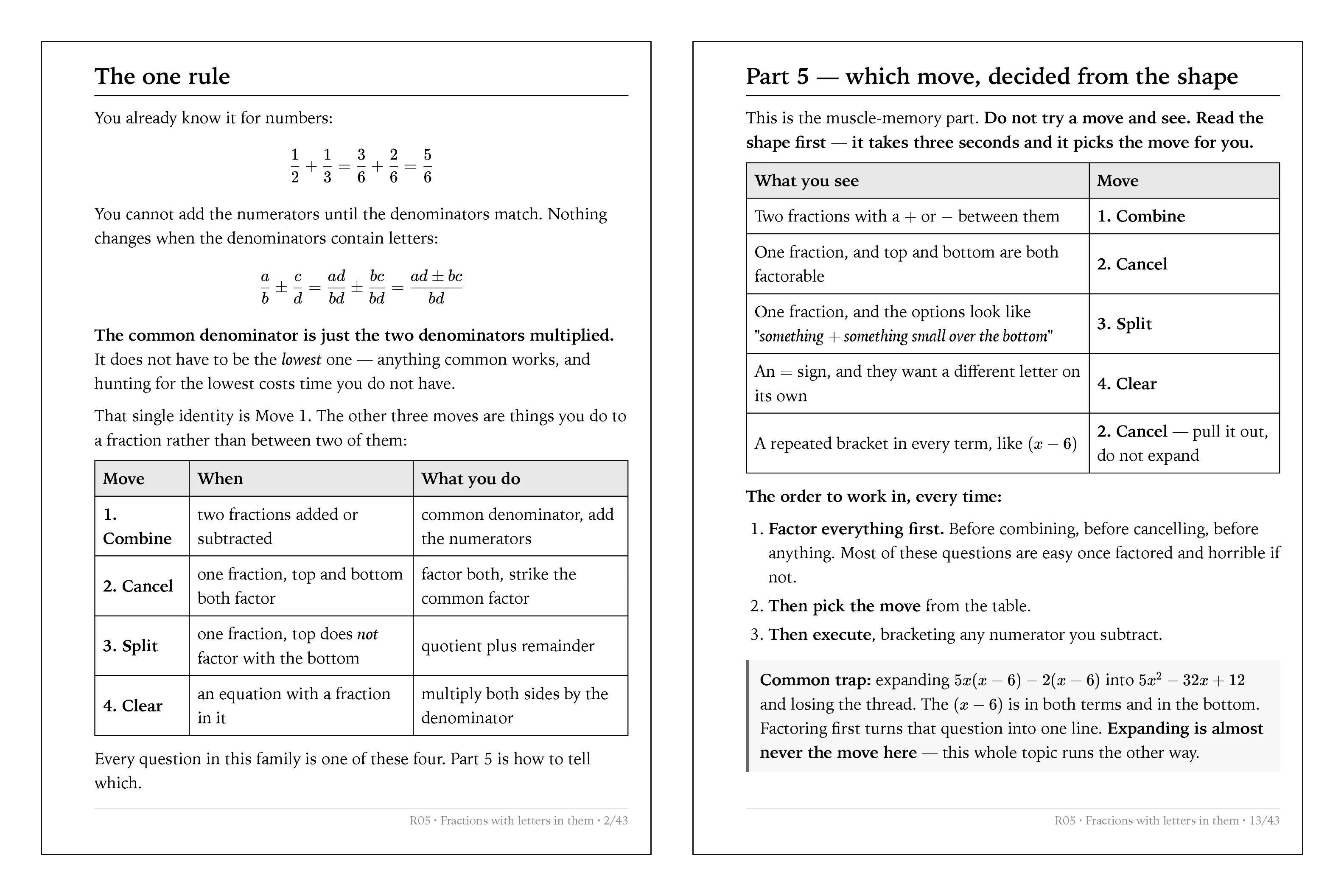
Two pages from one of the three sample sheets in the repo, on fractions with letters in them. These are written by hand, so nothing here comes from the College Board.
A drill is the one sheet picked automatically from my state, mixing the weakest types and spacing out repeats, and it only ever reuses a question I got wrong before, never one I got right (repeating one I got right would only test whether I remember the answer). Fourteen days after a remediation, the types it covered come back cold, with no notes, to check whether the fix actually held.
The other sheets
Everything above is the loop for maths, but there are a few other kinds of sheet, each named by a short code so I can tell them apart on the Supernote:
| Code | Sheet | Questions from | Timing |
|---|---|---|---|
| SW | Sweep | every type in one maths skill | per question |
| R | Remediation | hand-written pages, plus questions I pick | per practice question |
| DR | Drill | my weakest types | per question |
| MX | Mixed set or timed module | a representative sample of the whole bank | one clock, at real test pace |
| RW | Reading and Writing set | one skill, difficulties alternating | per question, or untimed |
| DS | Desmos drill | types one Desmos technique solves | 30 seconds a question |
Mixed sets are the rehearsal for the real thing. A timed module is 22 maths questions on one 35 minute clock, the real test’s rate rather than a round number, worked straight through with flagging and moving on, and when the timer goes I draw a line where I am. The number it produces is how many questions I reached, not a score, since accuracy on a set I didn’t finish mostly says which questions I happened to get to. They deliberately ignore my statuses, seeing as a set weighted towards my weak types would be harder than a real module and “questions reached” would stop meaning “kept test pace”. Reading and Writing and maths also run as separate sections with separate clocks, because that’s how the test does it.
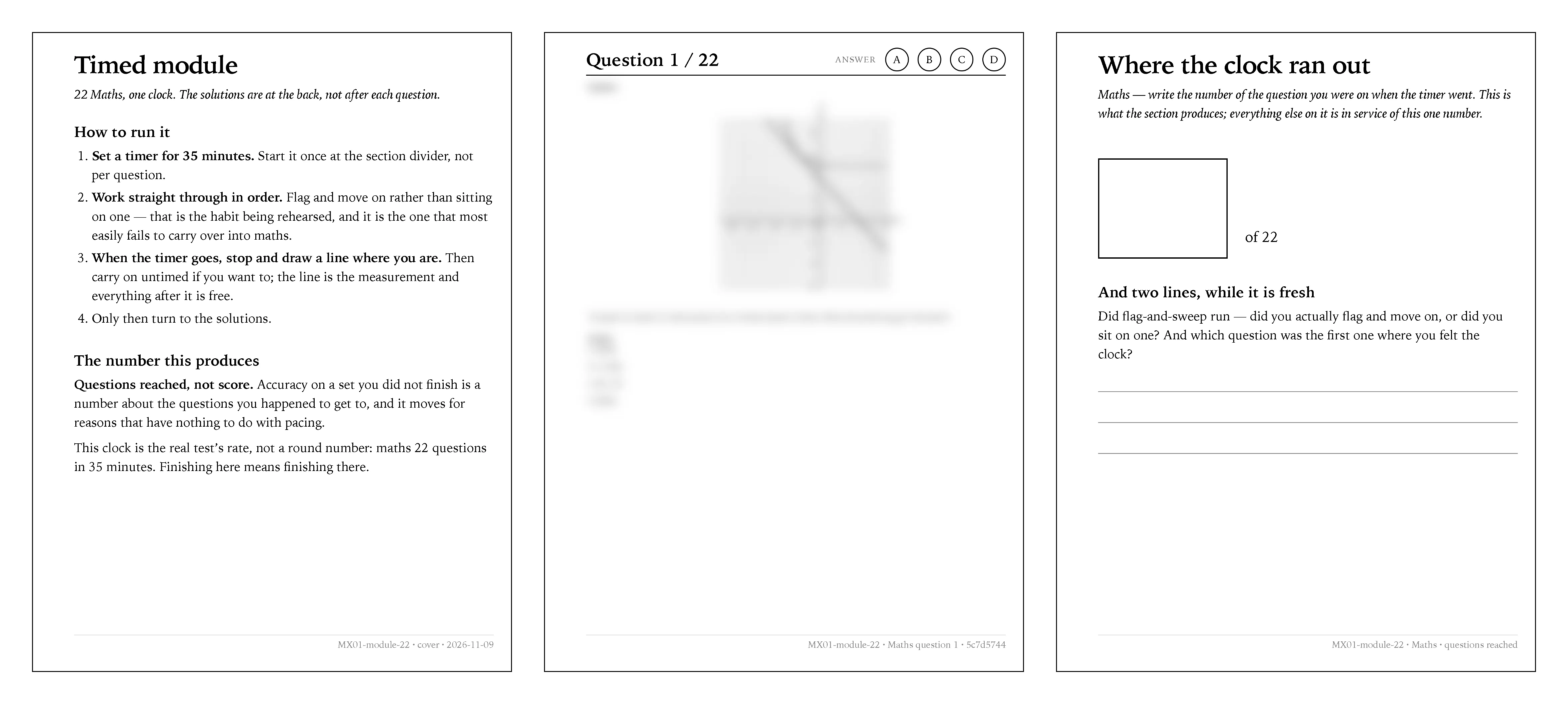
A timed module: the cover, the first question, and the page where I write down how far I got.
Reading and Writing doesn’t need the taxonomy at all. The unit of work is a run of sentence boundary questions in a row, which is just a filter on skill and difficulty, and the difficulties alternate rather than getting harder towards the end, so the set shows what the question type looks like instead of measuring stamina. A set can start with a rule card I wrote, and the time box can be turned off for habits that are meant to be slower than instinct, like reading to the end of the sentence before choosing. The Desmos drills are the odd ones out: they’re about the keystrokes rather than the maths, with a 30 second target, on questions that a fixed Desmos technique solves, like graphing both equations of a system and clicking where they cross.
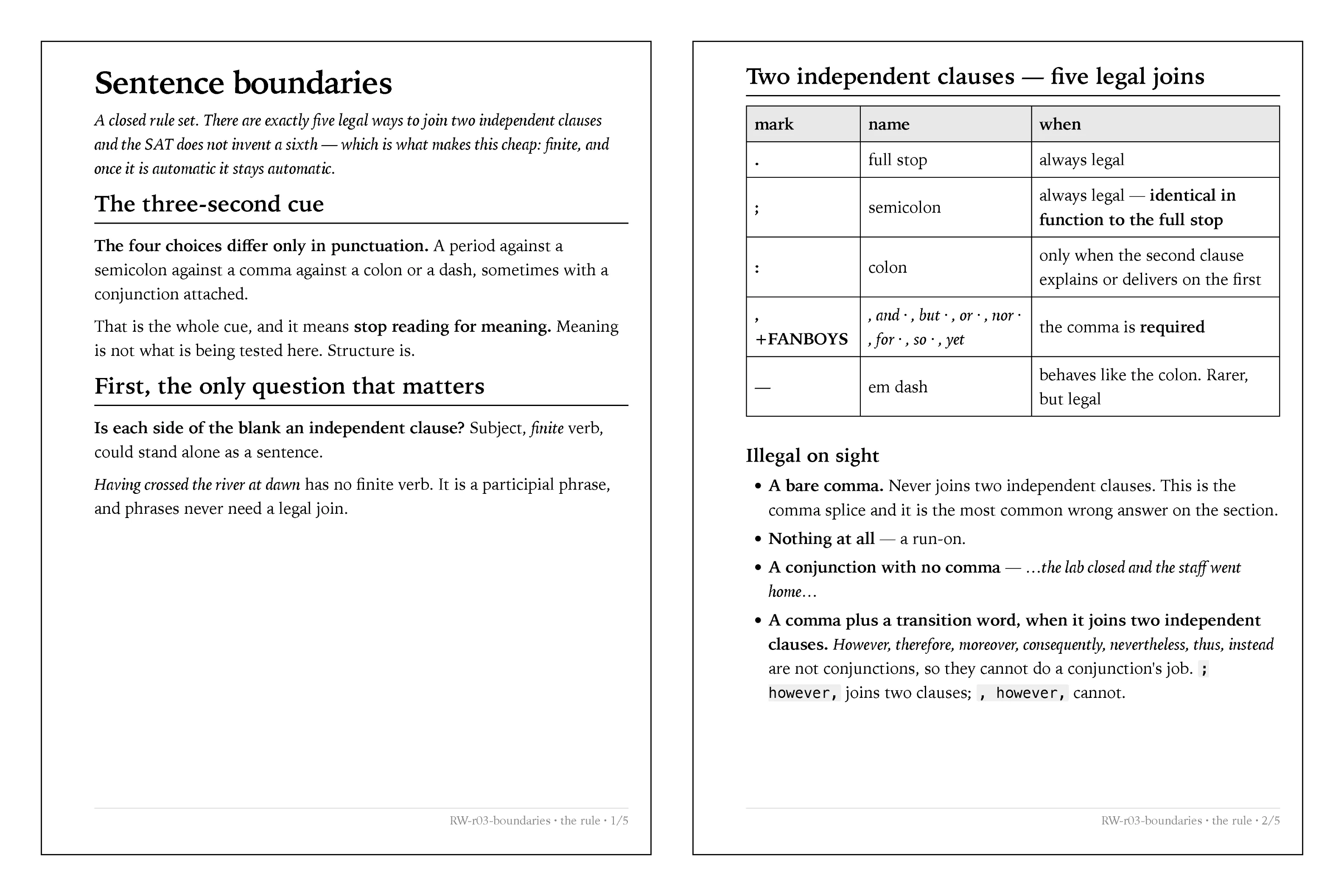
The rule card at the front of a Reading and Writing set, also one of the sample sheets in the repo.
The taxonomy
The College Board labels its maths questions with 19 skills, which are too coarse to act on (all of Advanced Math is three of them). So the system has three layers. The 19 skills are only used to filter the bank, 100 question types are what gets timed and carries a status, and 34 underlying skills, like factoring a quadratic or completing the square, are what a remediation sheet actually fixes. One underlying skill can sit inside several types, so when a few slow types share one, a single sheet fixes all of them, and that’s often the difference between a plan that fits in the hours I have and one that doesn’t.
The types came from having a model read cropped images of the questions, one skill at a time. The first attempt produced about 970 “types”, which was really a list of questions rather than a classification, and it took a hard cap on types per skill, batching by skill so the model could actually see repeats, and reading from images rather than text (about a fifth of the questions have almost no text, because the maths is an image) to get it down to 100. Assigning questions to types then used a closed list of labels, so the tagger had to pick an exact type or say “unmatched”. In the end 1,157 medium and hard questions are mapped to a type, and 80 of them honestly don’t fit one.
Building the sheets
I export the question bank as PDFs myself, and a small Swift indexer records each question’s ID, skill, difficulty and answer, along with the exact line on the page where the answer starts. Everything above that line becomes the question image, and everything below it becomes the solution. If that line can’t be found, the question is dropped rather than cropped at a guess, which loses about 5% of the bank but means an answer never shows up on a practice page, and a separate check goes through every row of the index to confirm it.
The sheets are real Supernote notebooks rather than PDFs, using the .note writer from xiehanzi, so on the device they’re just another notebook, and they can be pushed to the tablet and pulled back automatically. Selection is deterministic, so the same command always picks the same questions, and no question ever appears on two sheets. Builds also refuse rather than quietly losing content, so if something would be clipped off a page or a hand-written answer fails its check, no sheet gets made. Several of the bugs I found while building it passed every automated check and only showed up once I rendered a page and looked at it, so there’s a tool for exactly that.
In practice I hardly ever run any of the commands myself. I built most of the system together with Atlas, and it’s also what runs it day to day: it builds the sheets for the study blocks in my calendar and pushes them to the Supernote, and once I’ve written on one, it pulls the notebook back, reads my times and answers off the pages and records them. So the reviewer a sweep’s cover mentions is usually Atlas, and all that’s left for me is to sit down and open the sheet.
What’s in the repo
The repo has all the tools, the taxonomy with its 100 types and 34 underlying skills, the mapping of questions to types, and three sample sheets I wrote. It doesn’t contain any College Board questions, passages or answers. Anyone using it downloads the question bank themselves from the College Board’s free SAT Suite Question Bank, and their own progress starts empty. The project isn’t affiliated with or endorsed by the College Board, and SAT is their trademark.
Revisions
| Rev | Date | Change |
|---|---|---|
| A | 2026-11-09 | First published. |
| B | 2026-11-09 | Example sheets for each kind of sheet, and the mixed sets explained. |