FGS Share
- Ref
- U3
- Category
- software
- Status
- in use
- Year
- 2026
- Rev
- B
A self-hosted photo and file share for friends and family, my fork of Gokapi, running on the Mac mini at home.
FGS Share, at share.franco.international, is where my friends, my family and I send each other photos, videos and files. It runs on the Mac mini at home, the same one Atlas lives on, and it’s built on Gokapi, an open-source, self-hosted alternative to Firefox Send written by Marc Ole Bulling. Gokapi already did the hard back-end parts well: chunked uploads, expiring links, deduplicated storage, encryption, and sign-in through an identity provider. What I’ve added on top is mostly about what happens after the upload, when a dozen people are trying to look at, sort and save each other’s photos from a trip. FGS Share is public on GitHub and, like Gokapi itself, licensed under the AGPL.
I’d rather run this myself than put everyone’s photos in a Google Drive folder or a WhatsApp group. WhatsApp compresses everything, and with Drive the photos end up on someone else’s servers. This way the originals stay on a machine in my house, at full quality, for exactly as long as we agreed to keep them.
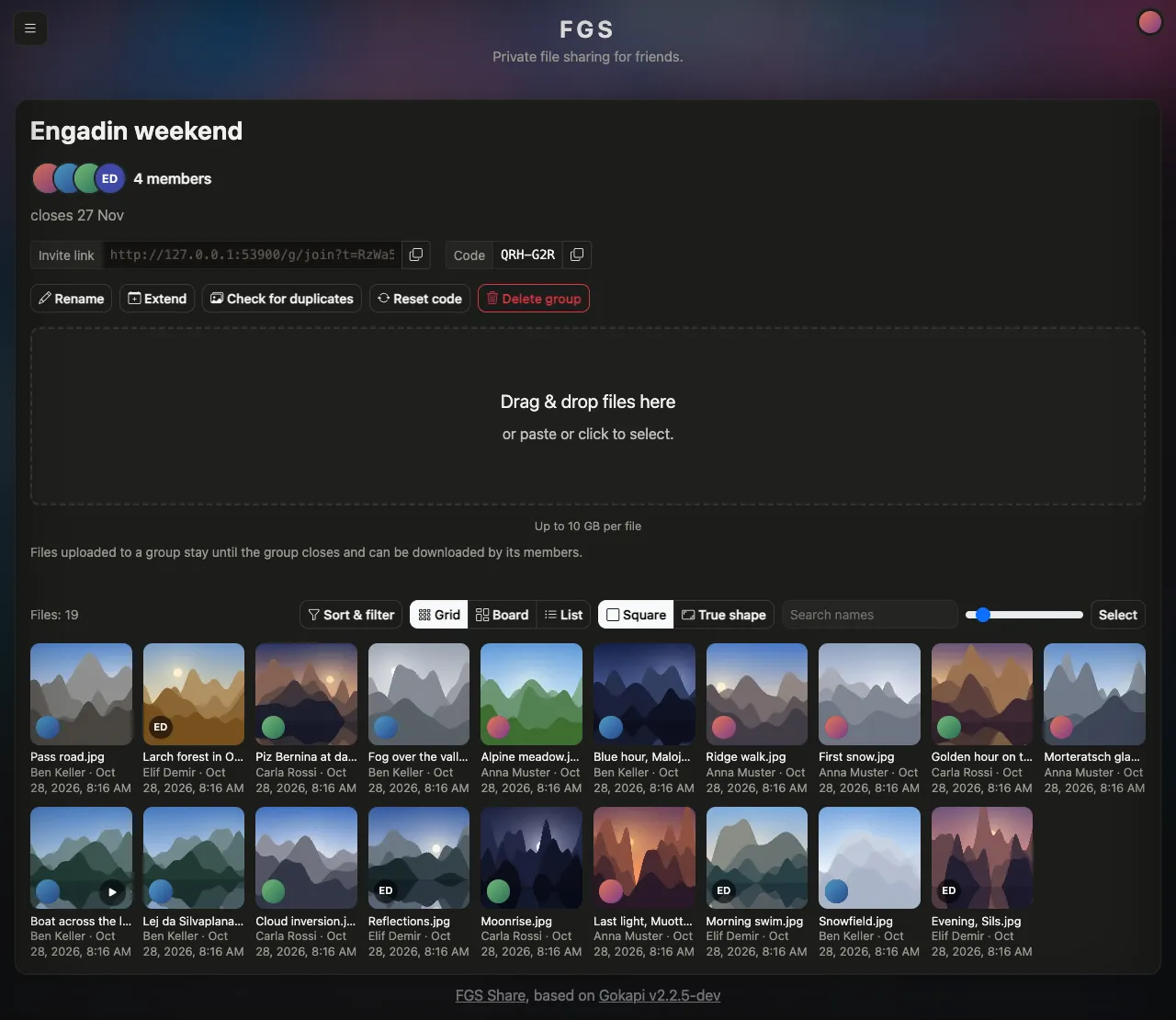
A group page, as its creator sees it. The people and photos in every screenshot here are made up, the photos drawn by a script for the purpose.
Why I forked it
I ran plain Gokapi from June, and it’s built for one person sending a few files to another, which it does really well. The hard case was a group trip. Everyone would sign in, upload their own photos and post a link to their own batch in the chat, which left everyone else with:
- no single place to see all the photos;
- no previews, so they downloaded everything and deleted what they didn’t want;
- no way of knowing what they’d already downloaded;
- duplicates, whenever someone re-uploaded a photo they’d got from someone else;
- “Download all” on an iPhone saving only the first file, because Safari allows one download per tap and silently drops the rest.
At the same time, I was getting an email for every single upload. Everything the fork adds answers one of those problems.
What the fork adds
The first addition, in August, was collections: several files behind one link, optionally with a password, so a batch of uploads becomes one thing to share instead of twenty.
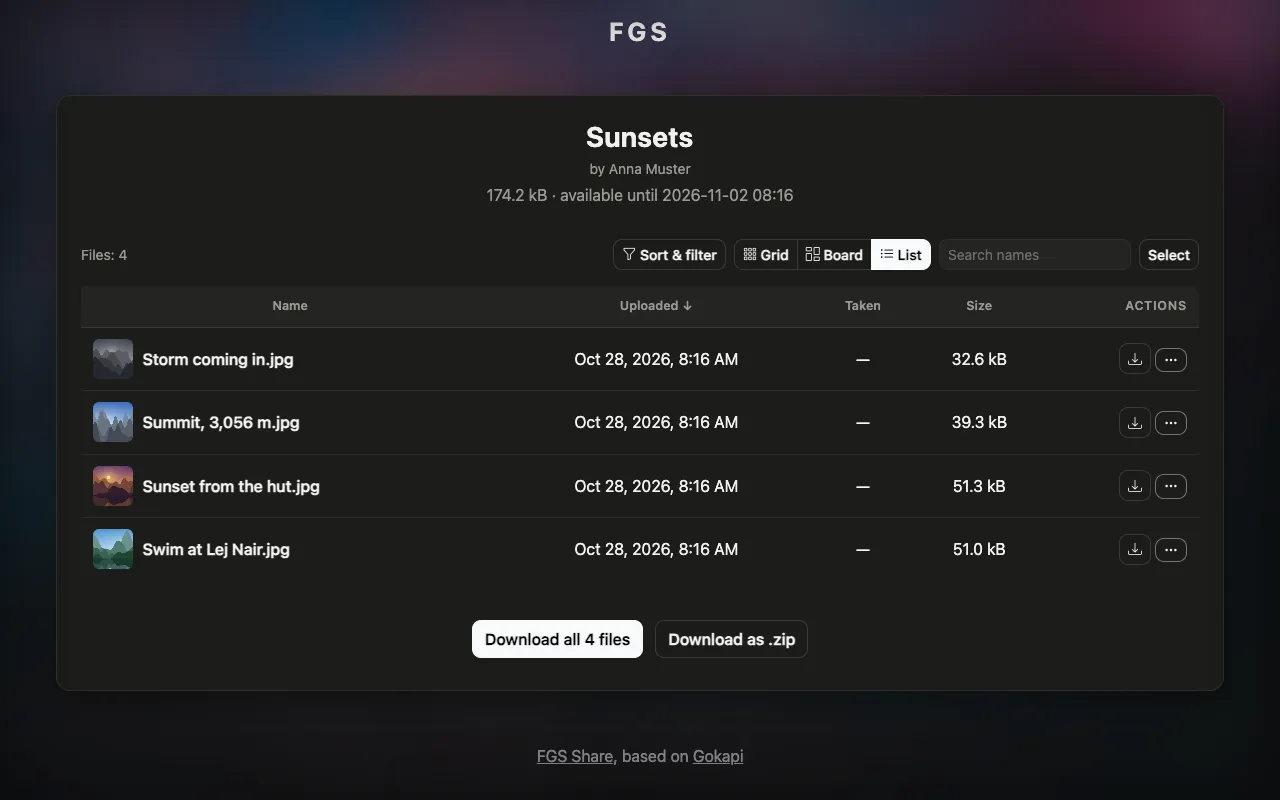
A collection, as anyone with the link sees it, without an account. Everything else came in October, in four parts that each went live on their own before the next one started.
Previews. Every photo and video gets a thumbnail, a larger preview and, for video, a poster frame. They’re made by a background worker that runs vips and ffmpeg as separate processes, one file at a time, so a malformed upload can only ever crash that one process, never Gokapi. It reads iPhone HEIC and MOV files as well as the usual formats, and keeps the date each photo was actually taken. Every list on the site, whether that’s your own files, a collection or a group, uses the same component, with a grid, a list and a masonry board that keeps each photo’s true proportions, and a full-screen viewer you can swipe through.
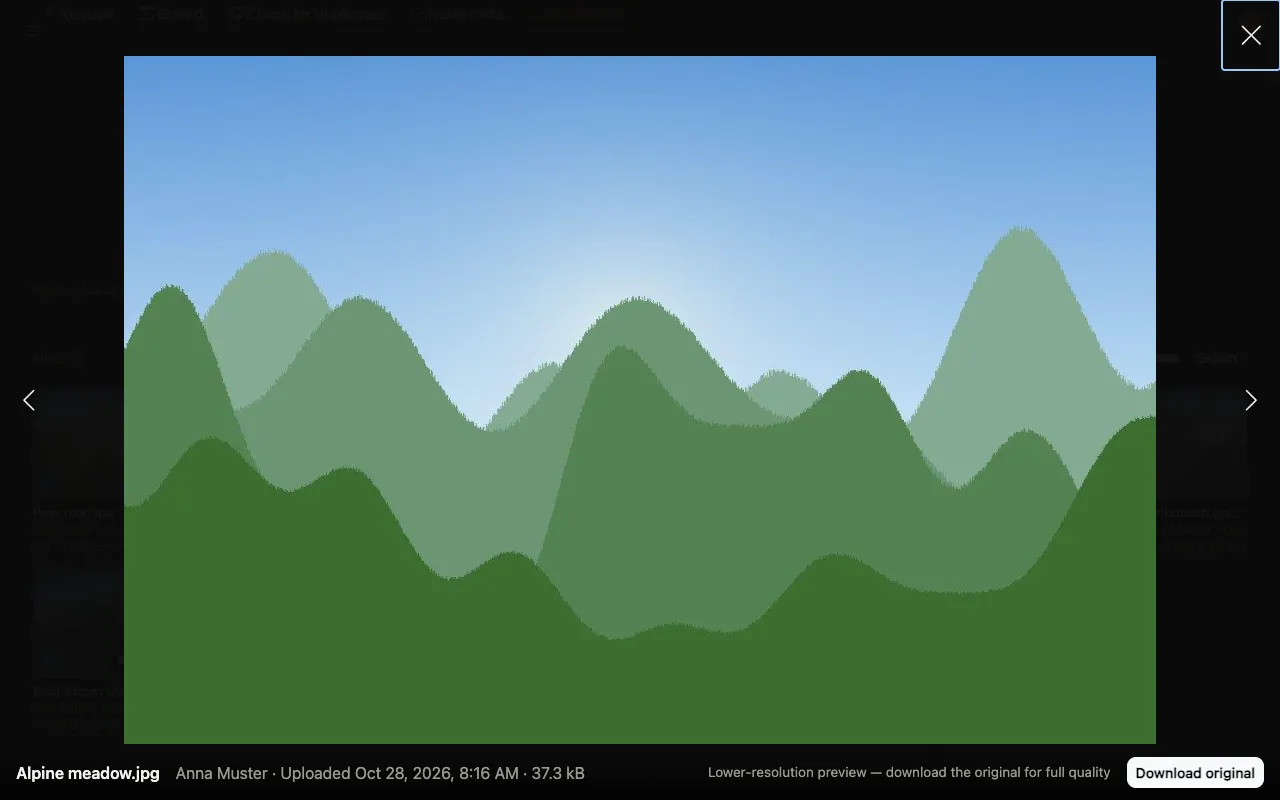
The viewer shows the smaller preview, and says so, with the original one click away.
Groups. Anyone signed in can create a group for a trip or an event, and others join through an invite link or a short code. Everyone uploads into the same board, ordered by when each photo was taken rather than when it was uploaded, and the board ticks off what you’ve already downloaded. Exact duplicates are caught in the browser before they’re uploaded, by comparing fingerprints, so nobody pushes the same video through twice. Near-copies, like the same photo exported twice or sent through a messenger, are flagged afterwards, and whoever uploaded the second one decides whether to keep it.
Getting photos onto a phone. On an iPhone, “Save to Photos” opens the share sheet in batches, so the photos land in the Photos app with their original date and time. For everything else there’s a zip, built on the server and streamed as it’s read, with each file’s date set to when it was taken, so the unzipped photos sort correctly.
Quieter notifications. A small Python script reads the site’s activity once a minute and turns it into a few emails instead of dozens. I get one summary once things have gone quiet, and anything that actually needs attention straight away, like a new person signing up or the disk filling up. Friends can choose to get at most one email a day, telling them their files were downloaded.
The fork also has per-person settings, a blocklist for sign-ins, and pagination that keeps lists of a few thousand photos fast on a phone.
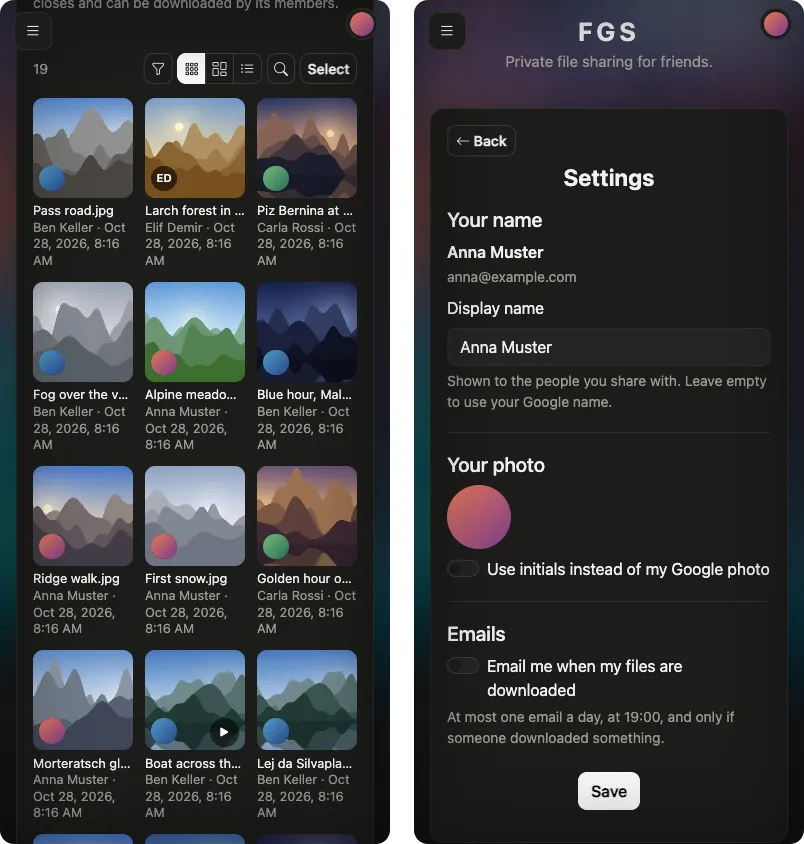
On a phone: a group’s photos, and the settings page where friends choose their name, their photo and whether they get the daily email.
How it runs
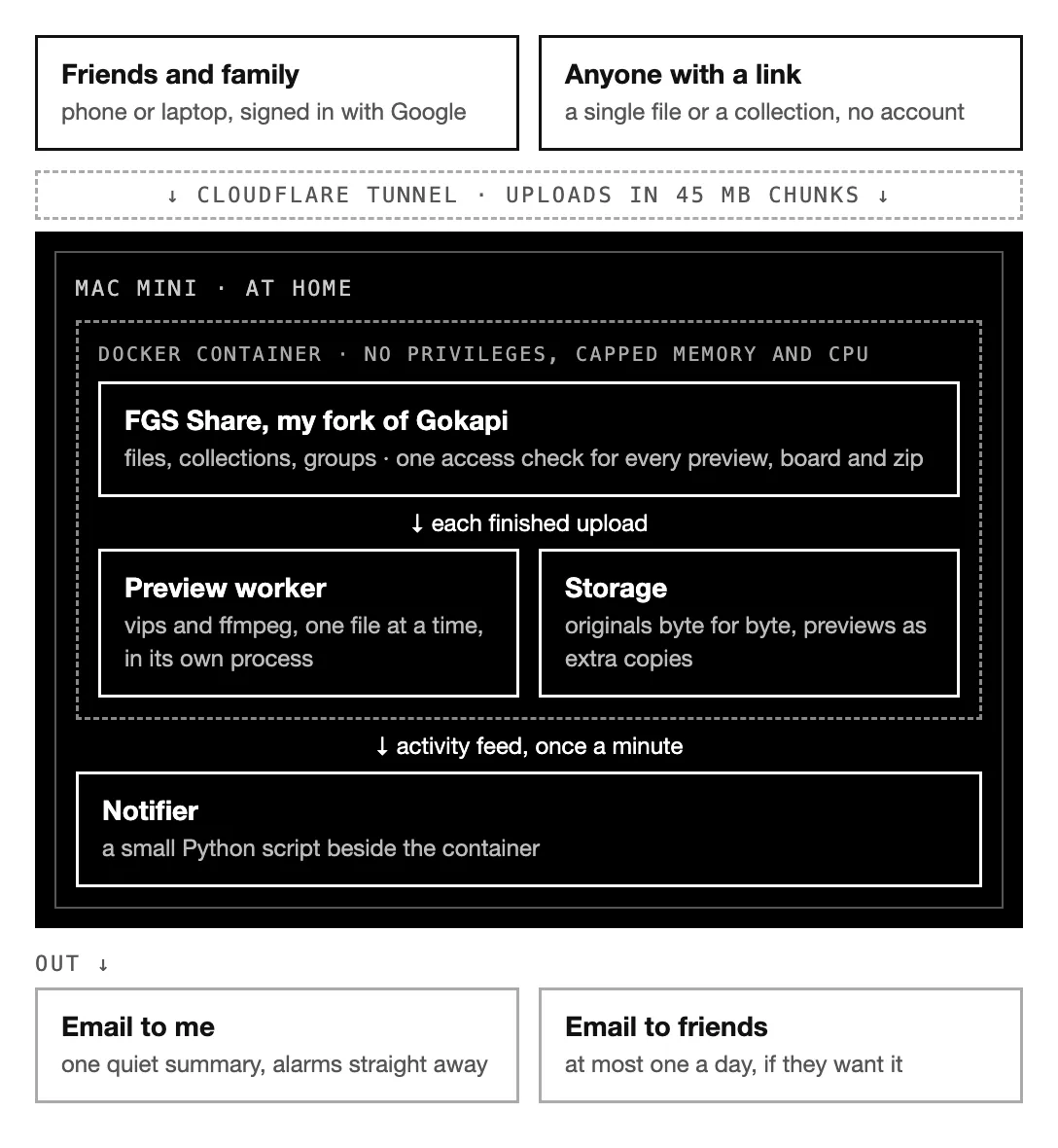
How a file gets in and what comes out. Everything inside the black box runs on the one machine.
The site runs in a Docker container on the Mac mini, and it isn’t directly reachable from the internet at all. The only way in is a Cloudflare Tunnel, which has one side effect worth knowing about: Cloudflare won’t accept a request bigger than 100 MB, so uploads are split into 45 MB chunks and put back together on the server. The container runs without any privileges and with capped memory and CPU, so that even if something in Gokapi went wrong, it couldn’t take the rest of the mini down with it.
Everyone who uploads or joins a group signs in with Google. Links to a single file or a collection still work without an account, as they do in plain Gokapi, and groups aren’t listed anywhere, so you only find out one exists if someone sends you its link or code.
A few rules it keeps
Originals are never touched. Uploads are stored and served back byte for byte. Thumbnails and previews are extra copies used only for display, and no download ever serves one instead of the original.
One access check for everything new. Every preview, board and zip goes through a single function that answers one question: may this request see this file? Previews are addressed by file, not by anything that could be guessed, so nothing new is reachable by trying URLs.
Stay close to upstream. New code lives in its own files, and the database schema hasn’t moved from Gokapi’s own version, so new releases of Gokapi still merge in cleanly. All the changes come with tests, including end-to-end browser tests that run against made-up users and photos, never real ones.
Revisions
| Rev | Date | Change |
|---|---|---|
| A | 2026-10-28 | First published. |
| B | 2026-10-28 | Card cover shows the whole group page. |